.png)



The problem: TikTok turned betting into theater
TikTok didn’t just change how people watch sports — it changed how they bet on them. Every week, a new “betting guru” goes viral calling out “locks,” “parlays of the year,” and “free money” picks. These clips rack up millions of views. Big energy. Flashy edits. Sometimes even big payouts.
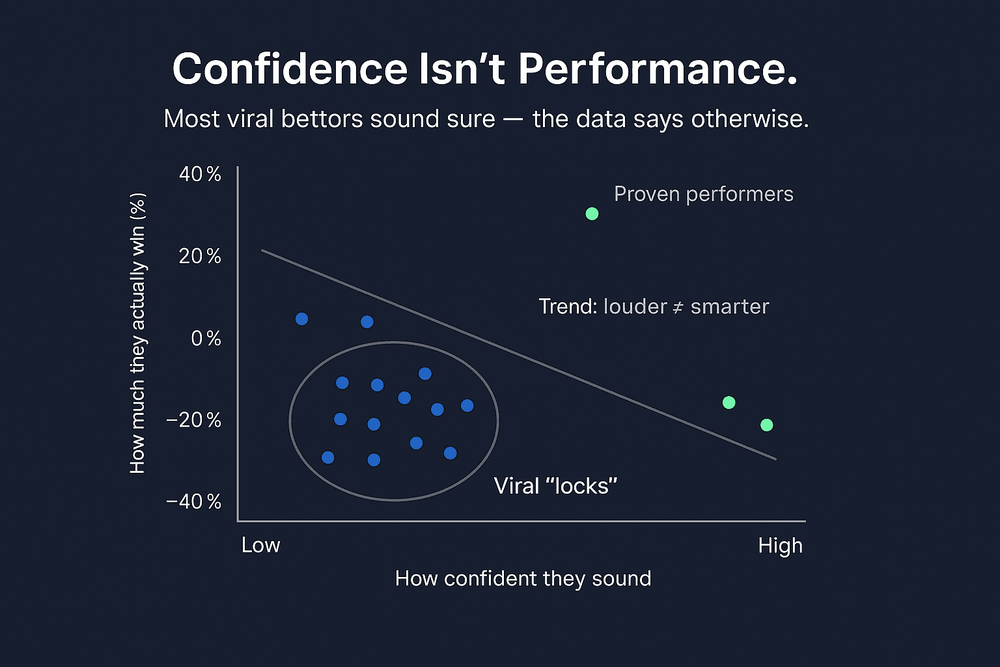
But here’s the truth: most of those creators aren’t winning long-term. They’re winning the attention game, not the math game.
TikTok’s algorithm rewards confidence, emotion, and charisma—not accuracy or accountability. And the people watching? They get hooked on hype dressed up as insight.
Viral betting content is optimized for attention — not profitability — and bettors who mistake confidence for competence usually pay for it.
👉 Related read: Why a 75% win rate can still lose you money
Why TikTok betting works (even when it’s wrong)
Let’s be clear: the TikTok betting scene isn’t dumb — it’s brilliantly optimized for attention. The creators understand something every influencer learns early: certainty sells.
Three psychological traps make their content so sticky:
- Confidence bias: People believe whoever sounds sure of themselves.
- Narrative bias: We remember big wins, not average results.
- Social proof: Follower counts look like credibility.
The result? Millions of bettors following entertainment disguised as expertise.
A bettor sees a creator hit three parlays in a row and assumes they’ve found the holy grail. What they don’t see are the 47 losing tickets buried under the pile.
That’s not analysis — it’s survivorship bias with a ring light.
👉 Related reads:
- The 7 myths in sports betting and what actually works
- Harvard Business Review: The Confidence Trap in Decision-Making
The economics behind viral betting
Here’s something most bettors don’t realize:
Many viral betting creators don’t actually need to win bets to make money.
Their business model isn’t built on ROI — it’s built on attention.
Creators monetize through:
- Sportsbook affiliate links
- Paid Discord memberships
- Subscription pick services
- Ad revenue
- Sponsorship deals
When income is tied to clicks and conversions instead of betting performance, accuracy becomes optional.
A creator can be wildly profitable while their followers quietly lose.
This creates a dangerous misalignment:
The bettor needs long-term edge. The influencer needs engagement.
Those are not the same goal.
And the algorithm doesn’t care who wins — it rewards whoever keeps people watching.
Once you understand that incentive structure, viral betting content becomes much easier to evaluate.
Not as analysis.
But as entertainment.
The missing metric: proof
Almost no viral TikTok betting account provides verifiable results. No logs. No historical data. No risk-adjusted performance.
In finance, that would be a compliance nightmare. In sports betting, it’s just content.
Without sample size, EV [expected value], or variance data, what you’re seeing isn’t analysis—it’s performance art. And when confidence becomes the metric, proof stops mattering.
That’s where Moddy changes the equation. Moddy tracks every creator’s model results in real time:
- Win rate
- Yield
- Volatility
- Historical performance
Anyone can see who’s actually producing value—and who’s just producing content.
Confidence vs. competence
There’s a reason TikTok’s betting culture feels intoxicating. It plays directly into the dopamine loop.
A big parlay hit triggers excitement. Watching someone else win triggers vicarious confidence. But over time, that system erodes discipline. You stop asking the only question that matters: “What’s their track record?”
This is where Moddy draws the line. Confidence isn’t the enemy — false confidence is. Real edge means showing your full data, not just your best day.
👉 Related read: Sports Handle — The Problem With Social Media “Cappers”
How Moddy fixes the accountability gap
Moddy exists because entertainment shouldn’t replace evidence. We’re not trying to make betting less fun — we’re making it measurably smarter.
Every model built on Moddy’s platform is:
- Tracked: Every prediction logged and scored.
- Transparent: Publicly viewable results, no selective screenshots.
- Powered by AI: Models continually retrain on new data, not old assumptions.
So if a creator really knows their stuff, Moddy amplifies them. If not, the scoreboard tells the truth.
👉 Related read: Why ChatGPT can't predict sports outcomes and what actually works
The bottom line: viral doesn’t mean smart
TikTok optimizes for attention. Moddy optimizes for evidence.
The difference is measurable:
- TikTok: Flash, hype, and selective storytelling.
- Moddy: Transparency, data, and tracked performance.
If you’re betting based on who sounds confident, you’re following noise. If you’re betting based on who performs, you’re following data. That’s the difference between guessing and winning intelligently.