.png)



Why win rate is a trap — and expected value (EV) is what really matters
Most bettors dream of a 75% win rate. That kind of record should make you rich, right?
Wrong. Here’s the uncomfortable truth: you can hit 3 out of 4 bets and still go broke — if you don’t understand expected value. Let’s break down why win rate alone means nothing in sports betting, how the math works against you, and how smart bettors flip the odds using expected value (EV).
Winning bets doesn’t guarantee profitability — only positive expected value does.
Why your sports betting win rate is lying to you
Let’s get one thing straight — win rate is one of the most misleading statistics in sports betting. It looks great on paper. It feels great to say. But it can completely mask whether you’re actually making money.
Here’s a real example that’ll blow your mind: Let’s say you’re playing it “safe,” betting on big favorites at -300 odds. You’re smart. You do your research. You’re winning 75% of the time — an elite hit rate. But at -300, you need exactly 75% just to break even.
Now drop that win rate to 73% — still excellent — and you’re losing money on every single bet.
That’s the trap: your win rate looks elite. But if your payouts don’t justify the risk, you’re bleeding cash while feeling like a genius.
Even at 74%, you’re still winning 3 out of 4 bets… and going broke.
The 75% win rate death trap (with math)
Let’s break this down. Say you’re betting $100 to win $30 (typical return on a -300 favorite), and you’re winning 75% of the time.
Here’s the expected return per bet:
- 75% of the time → win $30 = +$22.50
- 25% of the time → lose $100 = –$25.00
EV = $22.50 – $25.00 = –$2.50
So even with a 75% win rate, you're losing $2.50 per bet.
Place 100 bets? You’re down $250. That’s the math casual bettors ignore — and it’s exactly why win rate alone is a trap.
What actually matters: expected value (EV)
Expected value tells you how much you’ll make or lose on average, if you placed the same bet thousands of times.
The formula (don't panic)
Here's the basic math:
EV = (Win Probability × Win Amount) – (Loss Probability × Loss Amount)
Example: You bet $100 on a team at +150 odds.
- Win probability: 45% (your model or gut says they win 45% of the time)
- Win amount: $150 profit if you're right
- Loss probability: 55%
- Loss amount: $100
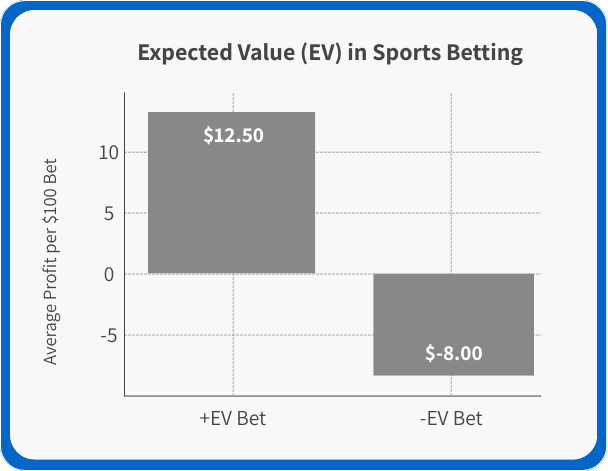
Plug it in: EV = (0.45 x 150) - (0.55 x 100) EV = 67.5 - 55 EV = +$12.50
That means this bet has a +EV of $12.50 per $100 bet. In the long run, it's profitable. It’s not complicated — but it’s the line between a winning strategy and a slow bleed.
Why most bettors lose (even the “sharp” ones)
According to sportsbooks and multiple independent studies, roughly 95% of sports bettors lose money long-term. Not because they don’t win. Because they:
- Bet on heavy favorites with terrible payouts
- Chase parlays for big wins without value
- Obsess over win rate and ignore the odds
- Bet emotionally instead of mathematically
The reality? If you're not thinking in expected value, you’re not betting — you're playing the lottery.
What winning bettors actually know
Let’s walk through what separates the 5% of bettors who win from the 95% who don’t. It’s not magic. It’s math, mindset, and discipline.
🔢 You need to win 52.4% of bets at -110 just to break even
This is the break-even point thanks to the vig (the built-in cut sportsbooks take on each bet). If you're hitting 50%, you're not close. You're losing. And if you're not beating 52.4% consistently, you’re not profitable.
💰 The best bettors in the world win around 55–56%
That might not sound like much — but it's a massive edge over the long run. Professionals aren’t chasing 70% win rates. They're finding small, consistent edges and scaling them across hundreds or thousands of bets.
📉 Sportsbooks hold about 7–9% of all money wagered
This is the built-in house edge across the entire market. It’s not rigged — it’s just math. That edge means most bettors are swimming upstream. You need to be smart just to keep your head above water.
📊 Long-term profit comes from volume, not hot streaks
The pros aren’t worried about any single game. One bad beat doesn’t rattle them. Their edge plays out over hundreds of bets, where the math can actually work in their favor. If you’re sweating every outcome, you’re not thinking long-term enough.
📈 Bankroll management is everything
Even if you’re making +EV bets, bad money management can sink you. Bet too much, chase losses, or overextend on a hot streak — and you’ll torch your edge. Smart bettors use strategies like the Kelly Criterion to size bets relative to both edge and bankroll.
Pros treat this like investing — not entertainment, and definitely not guessing.
So how do you actually bet with an edge?
The truth is, finding +EV bets on your own is hard. You have to:
- Estimate true probabilities
- Compare them to odds across books
- Understand break-even thresholds
- Track performance over time
Most bettors simply don’t have the time — or tools — to do that consistently. That’s where platforms like Moddy come in — built to surface value, not just picks.
Moddy isn’t one model or one guy’s gut pick — it’s a system
- Thousands of predictive models, built by real creators
- Moddy tracks how each model performs over time — which ones actually make money
- Moddy combines predictions from the best models to recommend smarter bets
- Only bets with a meaningful edge — usually 3%+EV — make the cut
- Every recommendation shows the projected win rate, implied odds, and breakeven threshold
In other words, Moddy acts like a filter — surfacing bets where the math is clearly in your favor, based on historical performance and real predictive lift.
Most bettors never see this kind of transparency. They follow vibes or “experts” — not data.
Moddy isn’t magic. It won’t win every bet. But it helps you stop guessing and start betting like the numbers matter — because they do.
The bottom line
Here’s the truth:
You can win 75% of your bets and go broke. Or you can win 53% and get rich.
The difference? It’s not luck, and it’s not some secret system. It’s math.
The few bettors who win long-term aren’t lucky or psychic — they’re disciplined, consistent, and obsessed with expected value.
So the next time someone flexes their 70% win rate, ask one thing: What’s their ROI?
Because in this game, win rate is vanity. Expected value is sanity.
Further reading
- How to calculate expected value in betting - Smarkets Help Centre
- 10 Reasons You Lose Money Sports Betting Every Season - OddsBoard
- Winning Percentage of Professional Sports Bettors - ElitePickz
- How to Calculate Expected Value in Betting - BettorEdge
- 14 Reasons Why You Lose At Sports Betting - Total Football Analysis
- What Percent of Bets to Win to be Profitable? | The 52.4% Strategy - Leans.ai
- How does EV betting work? - Reddit r/sportsbook
- What Percentage of Sports Bettors Are Profitable Long Term? - BoydsBets
- Sports Betting Rigged? How Sportsbooks Always Win - Birches Health
- How to Calculate EV in Sports Betting - Oddschecker
- Why 95% of bettors lose money - Reddit r/sportsbook
- Why is a 70% Win Rate Unrealistic When Betting on the NFL? - Sports Insights
- Odds Expected Value Calculator - OddsJam
- Are Americans Betting Their Future on Sports? - Investopedia
- Win-Loss Tracking vs. ROI Tracking in Betting - BettorEdge