.png)



Sports betting is starting to look like trading — here’s what’s actually happening
If you’ve heard people say things like:
- “Sports betting is basically trading now.”
- “Prediction markets are going to replace sportsbooks.”
- “It’s turning into Robinhood, just for sports.”
…it can sound exciting, confusing, or just loud.
Strip away the headlines and a simpler reality emerges:
The mechanics of betting are evolving — but the real shift is happening underneath.
This guide explains:
- What is actually changing
- Where Kalshi, Robinhood, and DraftKings fit
- What is not changing
- Why intelligence — not the platform — is becoming the durable edge
No hype. No jargon. Just structural clarity.
Start with a simple mental model
Think of sports betting and market trading as points on a spectrum, not two separate worlds:

- Sportsbooks sit on the left
- Financial markets sit on the right
- Prediction markets are emerging in the middle
Now they are drifting toward the same center — where outcomes are priced, probabilities are traded, and decisions look increasingly like portfolio management.
But to understand why this matters, start with a familiar catalyst.
Why Robinhood changed user behavior (not markets)
Robinhood is a stock & crypto trading app that made trading feel simple:
- Tap-to-buy UI
- No commissions
- Feels like using your phone, not a finance terminal
It didn’t reinvent financial markets; it reinvented access. Trading suddenly felt:
- Instant
- intuitive
- mobile-first
- frictionless
You weren’t logging into a brokerage terminal anymore — you were tapping a screen.
Robinhood normalized a powerful behavior: participate in markets directly.
That behavioral shift is now showing up in sports outcomes.
Enter Kalshi.
Kalshi: when outcomes become financial contracts
Kalshi is a CFTC-regulated financial exchange where real-world events trade like commodities. You trade outcomes the same way you’d trade oil, corn, or interest rates.
Each contract is priced between $0 and $1, representing the market's implied probablity:
- $1 if the event happens
- $0 if it doesn't
Example:

If the Chiefs win → the contract settles at $1. If not → it settles at $0.
What makes this structurally different from a sportsbook is what happens between entry and settlement.
Participants can:
- buy positions
- sell early
- hedge exposure
- react to new information
This is not wager behavior.
It is market behavior.
And regulators are paying attention. The National Collegiate Athletic Association (NCAA) has already challenged whether certain college-sports contracts functionally resemble sports betting — highlighting just how thin the boundary has become.
Because once probability is priced…
…it can be traded.

The convergence is no longer theoretical
Over the past year, signals of structural convergence have accelerated:
- National Hockey League (NHL) licensed its marks to prediction platforms — the first major U.S. league to do so.
- Robinhood introduced event trading to retail users.
- DraftKings acquired Railbird to expand exchange-style capabilities.
These are not product experiments.
They are category signals.
Betting and trading are no longer cleanly separable.
They increasingly share:
- pricing mechanics
- probability models
- risk management behaviors
- real-time information flows
The question is no longer:
“Is this betting or trading?”
The real question is:
Who prices uncertainty better?
What actually changed (and what didn't)
Here is the mistake many observers make:
They assume platform innovation creates the edge.
Historically, that was sometimes true.
But as interfaces standardize, advantage migrates elsewhere.
When everyone can tap “buy,” the only durable separation becomes:
- signal quality
- modeling sophistication
- speed of interpretation
In other words:
The edge shifts from execution → intelligence.
This is the quiet transformation underneath the noise.
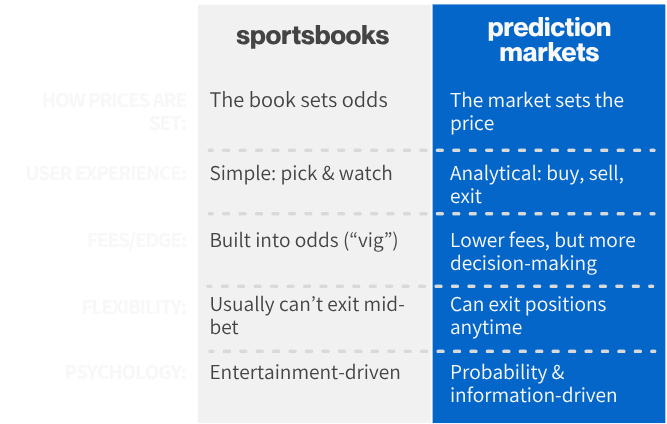
Sportsbooks vs. prediction markets: coexistence, not replacement
Prediction markets are not about to eliminate sportsbooks.
They serve different psychological and behavioral needs.
Most bettors still want a simple experience:
Pick a side.
Watch the game.
Feel the outcome.
Managing positions like a trader is a different mindset — one that will grow, but not universally.
The future is not replacement.
It is parallel evolution.
Entertainment-driven wagering will remain massive.
Market-style participation will expand alongside it.
Both can thrive.
But both reward sharper decision-making.
What this means for participants
As pricing becomes more explicit, one skill compounds in importance: understanding probability.
Because whether you are:
- betting a spread
- buying a contract
- exiting at halftime
…the core question is identical:
Is this price efficient?
Most people cannot answer that confidently.
Which is exactly why intelligence layers are emerging.
Why Moddy sits above the platform wars
Moddy does not try to be a sportsbook.
It is not an exchange.
It is not a picks service.
Moddy is the intelligence layer.
We help you:
- Interpret what odds actually imply
- Identify mispriced probability
- Track model performance over time
- Prove edge instead of guessing
If the future leans toward exchanges — Moddy already speaks probability.
If sportsbooks remain dominant — Moddy still sharpens decisions.
Platforms will evolve.
Interfaces will change.
The need for better signal will not.
That makes intelligence structurally durable.
What to watch next
Several forces will determine how quickly this convergence accelerates:
- jurisdictional tension between federal regulators and state authorities
- brokerage platforms expanding into event contracts
- sportsbooks experimenting with exchange mechanics
- additional leagues entering the space
The tipping point will not be technology.
It will be familiarity.
Once users grow comfortable treating outcomes like assets, behavior follows quickly.
The deeper shift most people are missing
The industry is not just getting bigger.
It is getting smarter.
Participants are beginning to ask better questions:
Not
“Who should I bet on?”
But
“Is this probability priced correctly?”
That is the intellectual maturation of the market.
And as betting and trading converge, the advantage will increasingly belong to those who understand:
- probability
- value
- model performance
—not those chasing narratives or hot streaks.
The bottom line
The environment will keep evolving.
But one principle is becoming clearer:
Edge will belong to those who interpret uncertainty better than the market.
Moddy exists for that future.
A future where outcomes are priced — not guessed.
Where performance is tracked — not implied.
Where edge is demonstrated — not claimed.
Platforms may shift.
The signal is what endures.
Further reading
- CME Group: What is a Futures Contract? – Overview of how futures work in financial markets
- CFTC on Prediction Markets – U.S. regulator’s stance on prediction markets and event contracts
- CNBC: DraftKings Market Share – Coverage of DraftKings and FanDuel dominance in U.S. betting
- Betfair Exchange Guide – How peer-to-peer betting exchanges work in practice