.png)



If you’ve ever heard someone say, “The Cowboys are 7-point favorites” and wondered what that really means, you’re not alone. The point spread is one of the most common and most misunderstood bets in sports.
The point spread isn’t a prediction — it’s the market’s attempt to price the difference between two teams.
Let’s break it down — no math degree required.
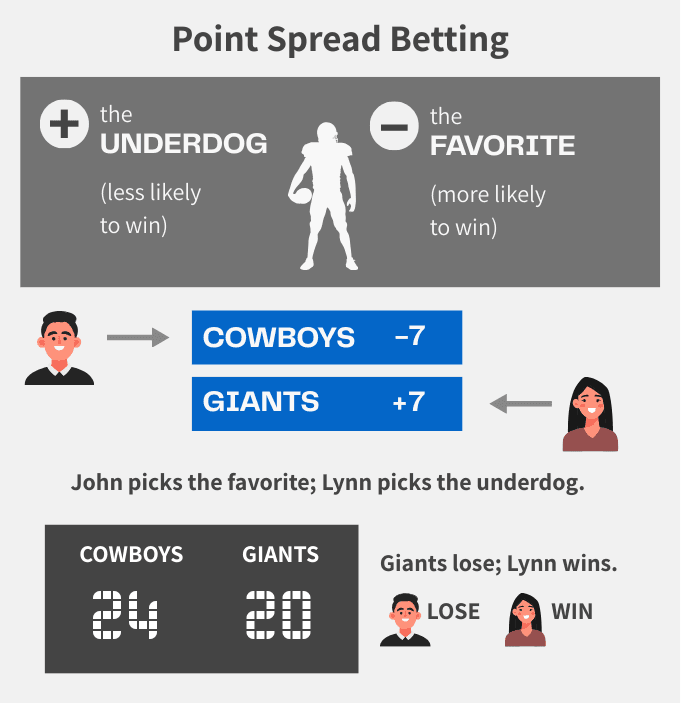
The point spread is a way to even the playing field between two teams. Instead of just picking who wins, you’re betting on whether the favorite can win by enough or whether the underdog can keep it close.
- The favorite is marked with a minus sign (–).
- The underdog is marked with a plus sign (+).
Example:
- Cowboys –7 vs. Giants +7
This means the Cowboys need to win by more than 7 points to “cover the spread.” The Giants can lose by up to 6 points (or win outright) and still “cover.”
👉 If the game lands exactly on 7? That’s a push — everyone gets their money back.
Why sportsbooks use spreads
If betting were just “pick who wins,” everyone would hammer the obvious favorites. Spreads balance action and keep games interesting, even when one team is much stronger. They also give you a reason to care about the fourth quarter of a blowout. Suddenly, that last-minute touchdown in garbage time matters — not for the win, but for the cover.
How odds work with the spread
Most point spreads come with odds around –110 on each side. That means you bet $110 to win $100. The –110 reflects the vig (the sportsbook’s cut). Sometimes lines shift to –115 or –105 depending on money flow.
Key terms to know
- Cover: When a team beats the spread (favorite wins by more than the line, or underdog loses by less than the line).
- Against the Spread (ATS): A team’s record factoring in spreads, not just straight-up wins. Example: a team could be 8-2 straight up but only 5-5 ATS.
- Hook: That half-point (like –7.5 instead of –7). Books love adding the hook to avoid pushes.
Real-life example
Let’s say the Eagles are –3.5 against the 49ers.
- If the Eagles win 28–24 (4 points), they cover.
- If they win 27–24 (3 points), they don’t cover.
- If the 49ers lose 27–25 (2 points), the 49ers cover.
That tiny “.5” makes all the difference.
Strategies for betting the spread
1. Shop for the best line
Not all books post the same spread. One might have –3, another –3.5. That half point is gold.
2. Watch key numbers
In football, margins like 3, 7, and 10 come up a lot. Betting +3.5 vs. +3 can change everything.
3. Fade the public
If 80% of bets are on the favorite, but the line moves toward the underdog, that’s a sign sharps are betting the other way.
4. Don’t ignore injuries & weather
A rainy game or a backup QB can swing spreads more than hype ever will.
5. Consider home-field advantage
Books usually bake in 2–3 points for the home team. But not all stadiums are equal — Lambeau in January isn’t the same as a half-empty dome.
Common mistakes bettors make
- Chasing favorites without considering the spread.
- Ignoring the hook — that extra half-point is brutal.
- Betting only on their favorite team. Your heart doesn’t care about ATS records, but your bankroll does.
The Moddy angle
This is where Moddy shines. Creators can build models that factor in:
- Team ATS performance
- Weather and travel
- Player injuries
- Matchup-specific data
Then bettors can follow the models that consistently beat the spread — no guessing, no hype.
The bottom line
The point spread is designed to make every game competitive — at least on paper. Learn how to read it, shop for value, and think like a sharp, and you’re already ahead of most bettors.
Next time someone says, “The Giants covered,” you’ll know exactly what they mean — and maybe you’ll be the one cashing in.