.png)



Ever check the odds on a game in the morning and notice they’re different by game time? That’s line movement — when sportsbooks adjust their odds or point spreads in response to betting activity, injuries, weather, or new information.
To untrained eyes, line movement looks random. It isn’t. But sharps (professional bettors) see it as a signal. Understanding how and why lines move not only makes you a smarter bettor, it helps you capture value before the market corrects.
Every line move reflects new information entering the market — and how sportsbooks respond to it.
The number matters more than the team.
What is line movement?
In sports betting, the line is the set of odds or point spread that a sportsbook posts for a game. Line movement happens when that number changes after the initial release.
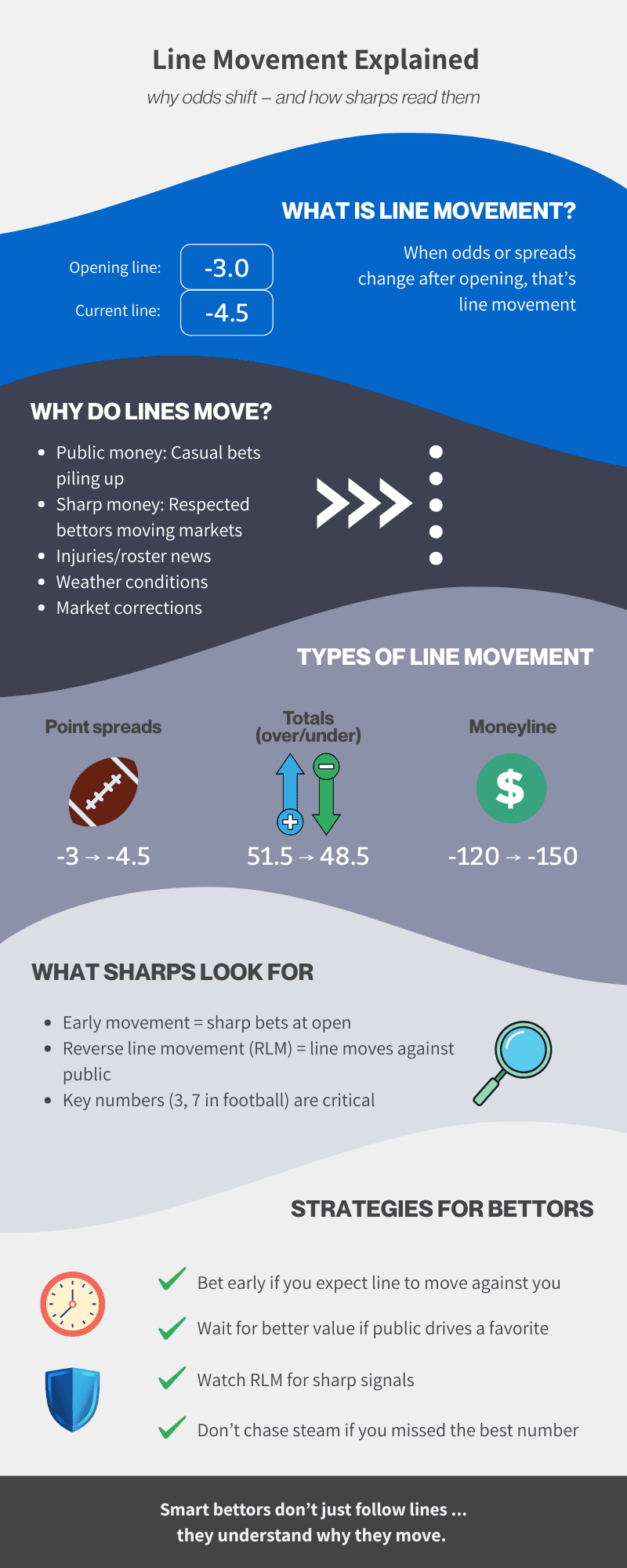
- Example: The Cowboys open as a -3 favorite against the Eagles. By game day, the line shifts to -4.5. That half-point to a full-point shift is line movement.
Movement can happen slowly over the week, or it can swing sharply in minutes if a big event hits (like a star player being ruled out).
Why do lines move?
1. Public betting
When lots of casual bettors hammer one side, sportsbooks may adjust the line to balance action and reduce their risk.
- Example: If 80% of bets are coming in on the Lakers -6, the book may move it to -6.5 or -7 to attract money on the other side.
2. Sharp money
Sportsbooks respect professional bettors. If sharps place large bets on a side, books may move the line quickly, even if the public is still leaning the other way.
3. Injury or lineup news
Player availability is one of the fastest triggers for movement. Quarterback ruled out? Expect an immediate swing.
4. Weather conditions
Particularly in football and baseball. Strong winds or rain can push totals (over/unders) downward as scoring expectations fall.
5. Market adjustments
Sometimes sportsbooks misprice an opening line. When the market pounces, they correct quickly.
Types of line movement
Point spread movement
- From -3 to -4.5 (favorite becomes stronger).
- From +7 to +5.5 (underdog gains respect).
Over/under (totals) movement
- A football game total opening at 51.5, dropping to 48.5 after weather reports.
Moneyline movement
- Yankees move from -120 to -150, showing increasing confidence they’ll win.
How sharps read line movement
Sharps don’t just watch that lines move — they watch how and when.
- Early vs. late movement: -- Early moves often signal sharp bets hitting as soon as books open. -- Late moves may reflect last-minute information or sharp money chasing value.
- Reverse line movement (RLM): When the line moves against the majority of public bets. -- Example: 70% of bets on Packers -3, but line moves to -2.5. This usually means sharps are betting the opposite side heavily.
- Key numbers: In football, spreads around 3, 7, and 10 are critical. Sharps jump on small moves that cross these numbers because they have an outsized impact on win/loss probability.
Why line movement matters to you
- It can tell you when to bet: Bet early if you think the line will move against you, or wait if you think movement will improve your price.
- It can reveal sharp vs. public action: Follow where respected money is going, not just where the crowd is betting.
- It teaches discipline: Chasing steam (late line moves) without understanding why can be dangerous.
Strategies for using line movement
1. Bet early when you expect the line to move against you
- If you like the favorite at -3 and expect public or sharp money to push it to -4 or -4.5, bet early.
- Locking in the best number gives you closing line value (CLV).
2. Wait if you expect better value later
- If you like an underdog and expect the public to pile onto the favorite, waiting can get you an extra half-point or more.
3. Follow reverse line movement carefully
- Example: 70% of bets on the Lakers -6, but line drops to -5.5.
- This suggests sharp money is on the dog. Following sharp signals can be profitable — but only if you confirm with multiple books, not just one.
4. Focus on key numbers in football
- Moving off -3 to -2.5 is massive (you go from needing a 4-point win to only a field goal).
- Moves off 6 or 7 are also critical. Smart bettors pounce when these numbers are crossed.
5. Track line movement across multiple sportsbooks
- Don’t rely on one book. Compare lines across the market.
- If one sportsbook moves but others don’t, it may be an overreaction. If they all move together, it’s real market consensus.
6. Don’t blindly “chase steam”
- Just because a line moves fast doesn’t mean you should jump on.
- If you missed the best number, you may be betting into a worse line with no edge.
Common mistakes bettors make
- Thinking all line movement = sharp action. (The public can also move lines.)
- Ignoring context (injuries, weather, travel schedules).
- Betting too late into “bad numbers” just because the line already moved.
- Forgetting the vig: moving from -110 to -120 is a subtle but costly shift.
Key takeaways
- Line movement shows how odds shift based on money, information, and market corrections.
- Sharps study the timing, direction, and key numbers of moves.
- Smart bettors can use line movement strategies to grab value and avoid bad prices.
Discipline matters: the goal isn’t to chase steam — it’s to consistently beat the closing line.