.png)


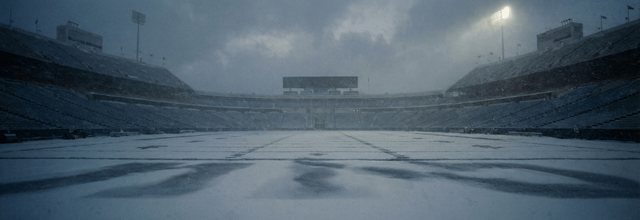
Weather is one of the few external forces that can shift both game plans and betting markets — but only when you know which conditions actually matter.
Wind, rain, snow, and temperature extremes influence how coaches call plays, how players execute, and how sportsbooks set lines. Smart bettors know to account for these shifts, while casual bettors often overreact, chasing myths like “snow game = auto under.”
This guide takes you beyond the clichés. We’ll look at the data, the nuances, and the strategies sharps actually use to turn weather into an edge.
Wind: the market mover
If there’s one weather variable bettors should respect, it’s wind. Unlike temperature or light precipitation, sustained wind directly interferes with the mechanics of football — passing, kicking, and even play-calling.
General impact bands:
- 0–7 mph: Minimal impact
- 8–12 mph: Deep passing becomes less efficient
- 13–18 mph: Books may begin shading totals downward
- 20+ mph: Drastic impact — passing volume drops, kicking becomes unreliable, and game plans often shift run-heavy
Wind doesn’t just affect the ball — it reshapes strategy. Coaches shorten field-goal range, punt more aggressively, and sometimes remove large portions of the passing playbook entirely.
Historic example: During the 2021 Patriots–Bills matchup, wind gusts exceeded 50 mph. New England attempted just three passes — and won.
Extreme wind doesn’t just suppress scoring. It changes how football is played.
Sharp angle: Totals usually adjust quickly. Player props often lag — especially passing yards and long field goals.
Kicking: the hidden wind opportunity
Where wind quietly creates value is in the kicking market. Some NFL analytics show FG percentage dropping from ~83.8% in <10 mph winds to ~76.9% in 20+ mph wind conditions. As wind rises, coaches become more conservative. Long attempts disappear. Fourth-down decisions change.
The betting market typically reacts to totals first — not specialist props. That delay can create opportunity.
Watch for:
- Longest field goal props
- Field goals made
- QB passing overs
Once sustained winds approach the mid-teens, these markets deserve attention.
Rain: more narrative than reality
Rain’s reputation among bettors is that it kills scoring. The truth? Light to moderate rain has little effect on totals. It’s only when downpours hit that things shift significantly.
- Light rain: negligible scoring impact
- Moderate rain: minor ball-security concerns
- Heavy downpour: meaningful disruption
Public bettors often hammer the under at the first sight of rain. Sportsbooks anticipate this behavior — and sometimes shade totals accordingly.
Sharp insight: Rain matters far more when paired with wind. Drizzle + calm air is largely noise. Rain + strong wind is a legitimate offensive constraint.
Snow: headline weather, misunderstood impact
Snow games grab headlines, but the betting reality is more nuanced.
- Light snow: can actually benefit offenses, as defenders struggle with footing
- Accumulation + wind: visibility drops, timing suffers, efficiency falls
The key question isn’t “Is it snowing?”
It’s: Does the snow materially affect footing and visibility?
If not, the betting market may overcorrect — creating value on the over.
Temperature: context beats thermometer
Temperature alone is rarely predictive, but extremes can matter — particularly when layered with team context.
- Heat: early-season games in southern climates often fatigue visiting defenses, creating late scoring environments
- Cold: veteran cold-weather teams typically adapt well. Problems arise when warm-weather or dome teams travel into harsh outdoor conditions.
The real danger combo: cold + wind.
Stacking conditions: when weather becomes actionable
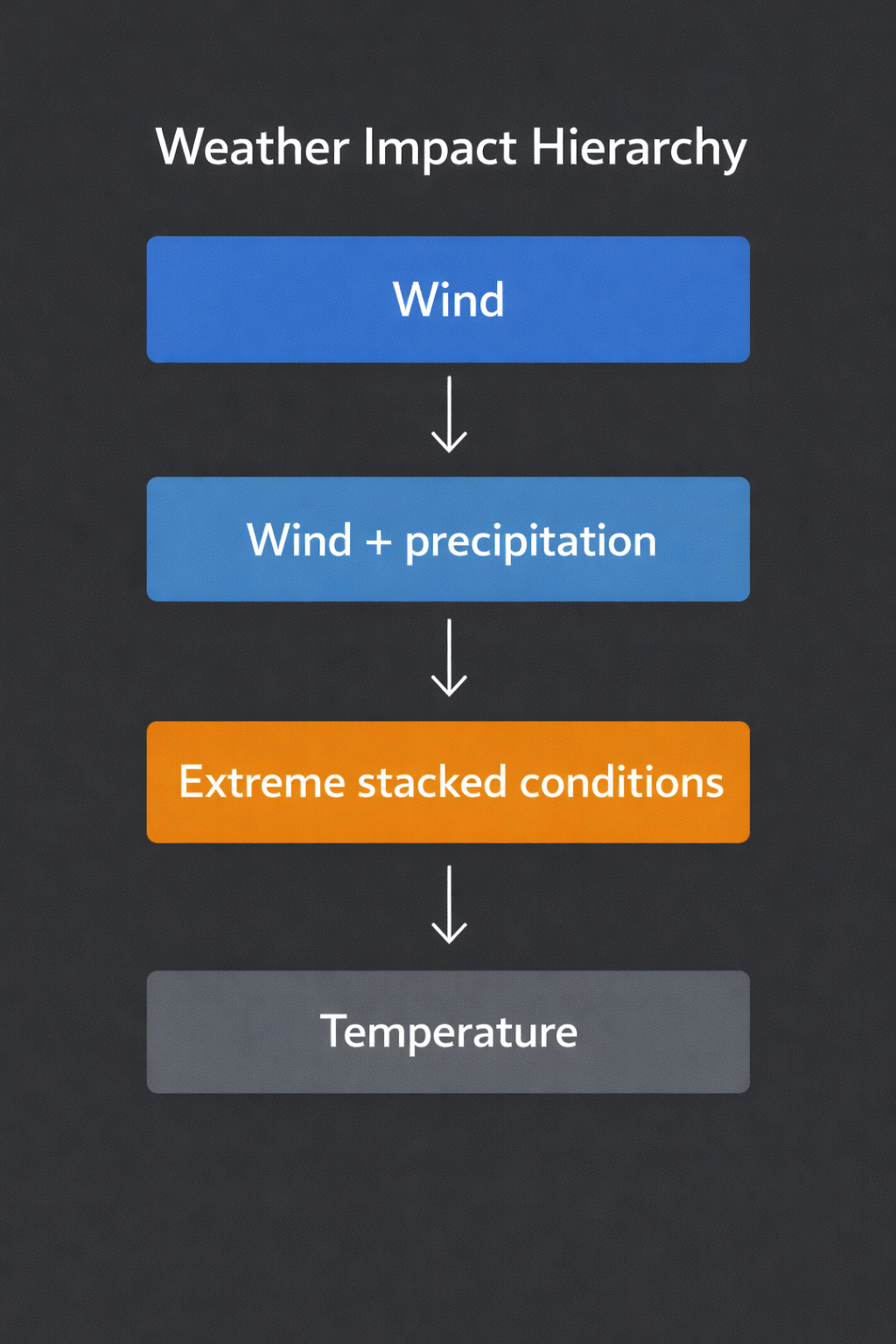
Weather rarely operates in isolation. The biggest edges emerge when factors compound.
- Wind + rain: passing efficiency collapses
- Cold + wind: strongest downward pressure on totals
- High altitude (Denver): extended kicking range
When conditions stack, sportsbooks often react — but not always evenly across markets.
How sportsbooks typically adjust
- Totals: first market to move
- Props: often adjusted later
- Spreads: move only when weather disproportionately affects one team
Understanding this sequence helps bettors identify where inefficiencies may appear.
Strategies sharp bettors use
Wait for forecast stability
Weather models improve dramatically within 24–48 hours of kickoff.
Avoid narrative betting
If a total crashes purely on weather hype, verify the actual conditions.
Match weather to team identity
Run-heavy teams often gain an advantage in poor conditions.
Look beyond the main markets
Props frequently present cleaner weather angles than spreads or totals.
Famous weather-driven games
2001 AFC Divisional Playoff - Raiders vs. Patriots ("Tuck Rule Game")
Heavy snow reduced passing efficiency and kept scoring contained.
2021 Week 13 – Patriots vs Bills (Orchard Park, NY)
Extreme wind forced a historically run-heavy game plan.
2024 Wild Card – Dolphins vs Chiefs (Arrowhead Stadium)
Subzero temperatures exposed Miami’s difficulty playing outdoors — reinforcing that context often matters more than raw temperature.

Beyond football
Weather influences multiple sports:
- Baseball: wind direction can materially affect run production
- Golf: gusts dramatically reshape scoring distributions
- Tennis: wind disrupts power servers more than baseline players
- Horse racing: track moisture changes performance profiles
Limits bettors should respect
Weather is powerful — but not predictive on its own.
- Sample sizes remain small
- Sportsbooks adjust quickly
- Matchups still matter more
Think of weather as a modifier, not a primary handicap.
How Moddy fits
At Moddy, weather isn’t treated as a narrative variable — it’s modeled.
We analyze how quarterbacks perform across wind bands, how kicking efficiency shifts, and how play-calling adapts under specific conditions.
Our goal isn’t to chase forecast hype.
It’s to quantify when weather truly changes probabilities — and when it doesn’t.
Key takeaways
- Wind is the most influential weather variable
- Rain and snow are often overstated
- Extremes matter most when layered with context
- Sharp bettors exploit market overreactions
- Data beats weather folklore
Further reading on weather & sports performance
- Weather, Wind Speed, and Temperature Effects on Football– Wharton research on weather bands and performance.
- Analyzing the Effect of Weather in the NFL – Data-driven look at passing, rushing, and kicking under different conditions.
- Going for Three: Predicting Field Goal Success – Sloan Sports Analytics paper modeling FG probability with weather.
- Temperature and Field Goals – Analysis of kick success under temperature and wind variations.