.png)


.png)
At first glance, sports betting odds can feel opaque at first glance. Plus signs, minus signs, fractions, decimals — it’s a lot. But once you know how to read odds, you’ll see they all encode the same two signals:
- How much you stand to win
- The implied probability of that outcome
Most sportsbooks use one of three traditional formats — American, Decimal, or Fractional odds. And in prediction markets or betting exchanges, you may also see contract price odds, which tie directly to implied probability. Let’s break them all down.
Odds aren’t predictions — they’re probability prices set by the market.
If you’re not thinking in probabilities, you’re not really interpreting the odds.
American odds explained
American odds are the most common format in the U.S. They use plus (+) and minus (–) signs.
- Positive odds (+): Show how much profit you’d make on a $100 bet. -- Example: +200 means a $100 bet wins $200 profit (total payout $300).
- Negative odds (–): Show how much you’d need to bet to win $100. -- Example: -150 means you must bet $150 to win $100 profit (total payout $250).
In short:
- + = underdog (higher payout, lower probability).
👉 Example: +150 means you risk $100 to win $150. –120 means you risk $120 to win $100.
Decimal odds explained
Decimal odds are standard in Europe, Canada, and Australia. They represent the total payout (profit + stake) for every $1 wagered.
- Example: 1.50 means every $1 bet returns $1.50 ($0.50 profit).
- Example: 3.00 means every $1 bet returns $3.00 ($2 profit).
Why sharps like decimals: They’re the easiest to work with for probability; you can instantly calculate your payout by multiplying your bet size.
Fractional odds explained
Fractional odds are traditional in the U.K. and horse racing. They show profit relative to your stake and look like traditional fractions: 5/1, 10/3, 2/7, etc.
- The fraction shows profit relative to stake.
- Example: 5/1 (“five to one”) means a $100 bet profits $500.
- Example: 2/5 means a $100 bet profits $40.
Fractional odds are less intuitive if you’re used to American or Decimal, but they’ve been around the longest.
Contract price odds (prediction market style)
Unlike traditional formats, contract price odds express outcomes as a price between $0.01 and $1.00 — and that price is the implied probability.
- How it works: A “Yes” contract at $0.65 means the market estimates a 65% chance of success.
- Settlement: If the event happens, contracts pay out $1.00. If not, they settle at $0.00.
- Profit: Settlement – Purchase Price = profit per contract. -- Example: Buy at $0.65. If it wins, you make $0.35 per contract.
👉 Contract price odds = implied probability directly. Unlike American/Decimal/Fractional, no conversion math is needed.
Odds conversion table
Here’s how the formats align for common lines:
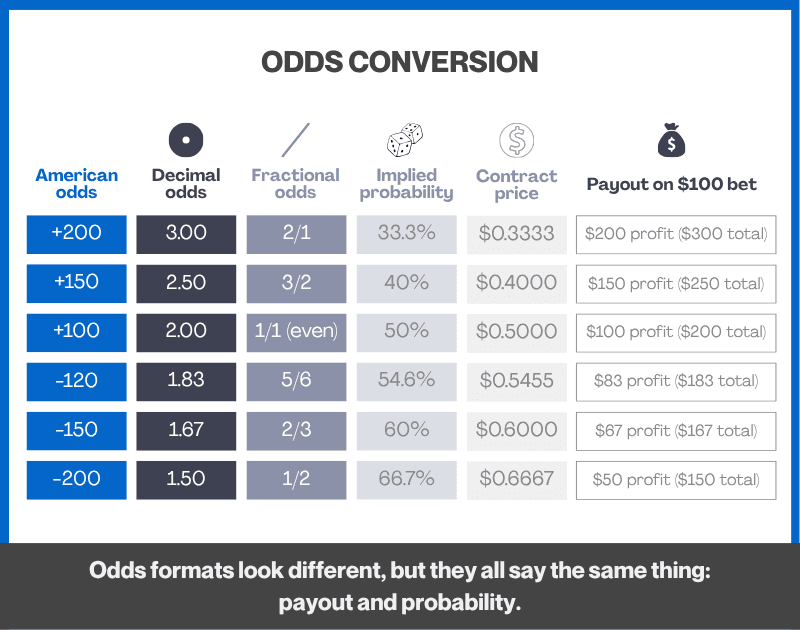
Note: Contract price gives implied probability directly — e.g. a $0.60 contract price means 60% implied chance of success. In prediction markets/contracts, if the event happens, a $0.60 contract pays $1.00; if it doesn't, it pays $0.00.
Implied probability: what odds really mean
Odds don’t just tell you the payout — they reveal the implied probability of an outcome: the chance an outcome will occur, as priced by the market.
Formulas:
- For American odds: -- Positive: Implied probability = 100 ÷ (odds + 100) -- Negative: Implied probability = -odds ÷ (-odds + 100)
- For decimal odds: Implied probability = 1 ÷ decimal odds
- For fractional odds: Implied probability = denominator ÷ (numerator + denominator)
Example:
- Odds of -150 → 60% implied probability
- Odds of +200 → 33.3% implied probability
- Odds of 3.00 (decimal) → 33.3% implied probability
👉 The “trick” is spotting when your estimated probability is better than the book’s. That’s what sharps call value betting.
Implied probability doesn’t guarantee an outcome — it’s the market’s best guess. Your edge as a bettor is finding when true probability is higher than the implied probability.
What is a push?
A push happens when the result lands exactly on the sportsbook’s line. In this case, your bet is refunded — you don’t win, but you don’t lose either.
Example:
- You bet Patriots -3.
- Final score: Patriots 27, Jets 24.
- Margin = 3 → It’s a push. Your stake is returned.
Impact: pushes don’t hurt your bankroll, but they erase what could’ve been a winning ticket. This is why sharp bettors care so much about getting the right number. Pushes don’t apply to moneyline bets (win/lose), but are common with spreads and totals.
Why this matters
- Odds formats are just different ways of saying the same thing — payouts and probabilities.
- Understanding implied probability is how you move from casual betting to sharp betting.
- Knowing what a push is (and how to avoid it) keeps your bankroll steady.
Key takeaways
- American odds show win amount (+) or bet amount (–).
- Decimal odds show total return.
- Fractional odds show profit relative to stake.
- Contract price odds show implied probability directly.
- Pushes: Tie = refund.
- No matter the format, it all reduces to: how likely is this to hit, and what’s the payout?