.png)



If sports betting feels like you’re always one step behind, it might be because you’re thinking like the public — while the pros (known as “sharps”) are operating from a completely different framework.
Sharps and the public often bet the same games, but their strategies, mindset, and goals couldn’t be further apart. Understanding the difference can help you spot value, avoid traps, and ultimately operate with an edge.
The market doesn’t punish bad picks — it punishes public thinking.
If you bet like the crowd, you inherit the crowd’s outcomes.
What is “the public” in sports betting?
“The public” refers to casual bettors — the majority of people betting for entertainment. Public betting is driven by:
- Favorites and overs: They love betting on winners and high-scoring games.
- Recency bias: They overreact to last week’s result.
- Star power: They follow big-name teams and players.
- Emotion: They bet on teams they like, or against teams they hate.
What is a “sharp” bettor?
Sharps are professional or highly disciplined bettors. They focus on:
- Expected value (EV): Every bet is judged on long-term profitability, not gut feel.
- Beating the closing line: Getting a number better than what the market settles on.
- Bankroll management: Risking a small percentage of bankroll per play.
- Information edges: Using injury news, matchups, or models before the market adjusts.
- Line shopping: Always finding the best price across multiple sportsbooks.
Key differences between sharps and the public
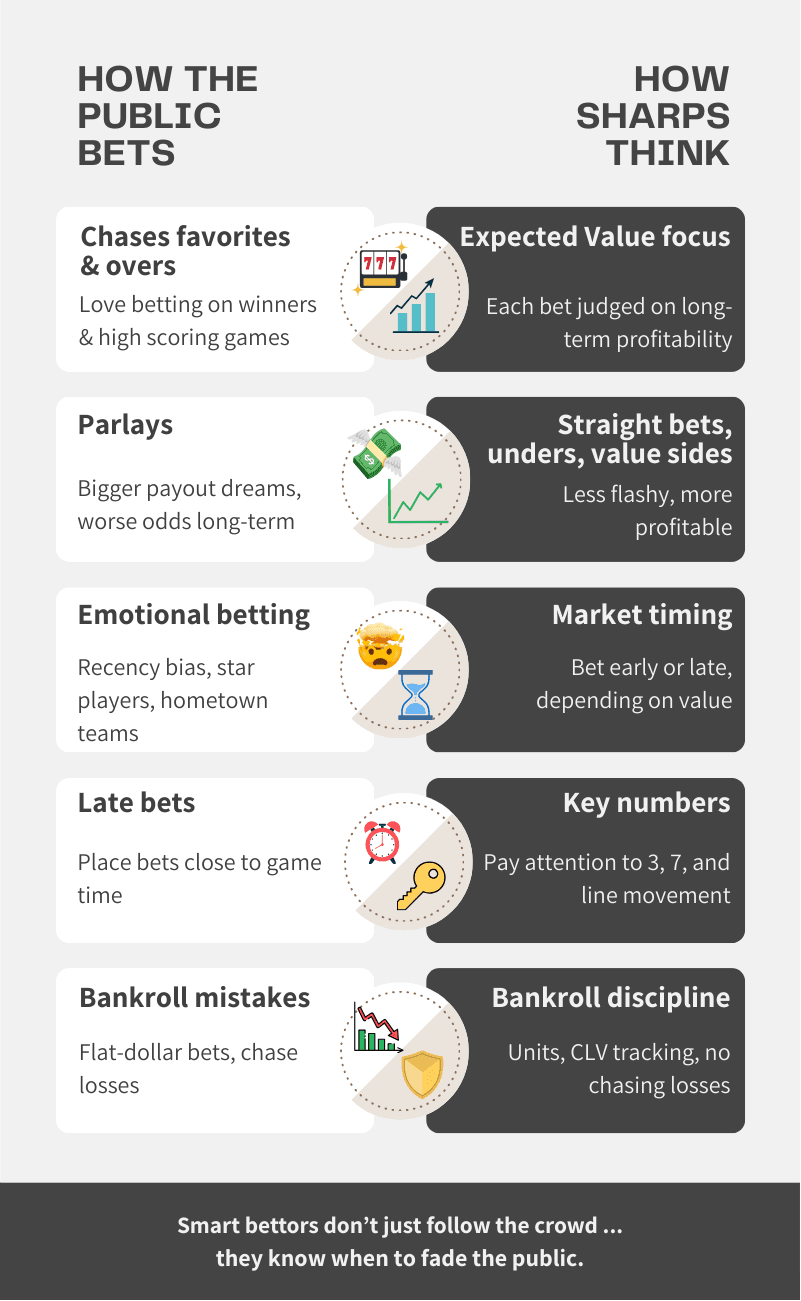
How sharps think — strategies in action
1. Market timing
Sharps know when to place bets. They often hit lines early if they expect movement, or wait for the public to push a line to create value.
2. Exploiting line movement
If 70% of bets are on the Chiefs -7 but the line drops to -6.5, sharps see that as reverse line movement — a sign of pro money on the other side.
3. Targeting key numbers
Sharps understand the value of a half-point. They’ll pay for -2.5 instead of -3.5, or hammer a teaser that crosses 3 and 7.
4. Betting ugly games
Sharps often bet on teams the public hates — underdogs, unders, and low-profile matchups. That’s where the market is softer.
5. Chasing long-term edge, not single wins
They accept variance. A sharp might go 3–7 in a week but still know they made +EV plays. The public often panics and changes approach.
Fading the public: does it work?
One of the most popular betting concepts is “fade the public” — betting against the side that most casual bettors are on.
The logic is simple:
- Public bettors are driven by emotion and biases.
- If 80% of tickets are on the Cowboys, oddsmakers know it — and they often shade the line against that side.
- That creates value on the other team.
But here’s the truth:
- Fading the public blindly is not a winning strategy.
- It works best when combined with other signals — like reverse line movement, sharp money indicators, or value around key numbers.
- Sharps don’t fade the public just because; they do it when market imbalance creates mispriced odds.
Why sportsbooks want public money
Books make their profits from the vig — and they love when casual bettors pile onto one side. Public money makes the market inefficient, giving sharps opportunities to strike.
When you hear about “sharps vs the public,” it’s usually because sportsbooks report lopsided action:
- 80% of tickets on one side (public).
- 70% of money on the other (sharps).
How to think more like a sharp
- Stop betting favorites and overs just because they’re fun.
- Track your bets in units, not dollars.
- Learn to love value, even if it means betting ugly sides.
- Bet early (or late) depending on where the value will be.
- Remember: It’s a marathon, not a sprint.
How Moddy helps you think like a sharp
At the end of the day, the difference between sharps and the public comes down to discipline and data. Sharps don’t rely on gut instinct or fandom — they rely on information, probabilities, and a long-term mindset.
That’s exactly what Moddy is built for. Our platform gives you:
- Data-driven models created by real bettors, not gut feelings.
- Performance tracking so you know which models consistently deliver value.
- AI-powered insights that cut through noise and help you spot sharp angles before the public moves the line.
Moddy isn’t about hype picks — it’s about thinking like a sharp, even if you’re not one yet.
Key takeaways
- Public bettors chase excitement. Sharps chase long-term profit.
- “Fading the public” can work, but only when paired with sharper indicators like line movement and key numbers.
- You don’t need to be a pro to think like one — just adopt the discipline.