.png)



Why relying on one model is leaving money on the table
Sports predictions are tough. Injuries, weather, coaching decisions, and that mysterious “sports magic” can throw off even the best analysts and AI models. For years, bettors chased the one perfect model – the algorithm that could crack the code. But here’s the truth: the perfect model doesn’t exist. There is, however, a better way to predict sports – and you’ve seen it every Saturday on ESPN.
What is ensemble modeling?
Ensemble modeling combines predictions from multiple models to create a single, stronger prediction. Instead of trusting just one approach, it builds a team of models that balance each other out and boost overall accuracy.
Ensemble modeling in action: College GameDay
Picture this: It’s Saturday morning. Millions tune in to ESPN’s College GameDay to hear the hosts’ picks.
- Kirk Herbstreit leans on stats and team performance.
- Desmond Howard brings player insights.
- Pat McAfee adds energy and wildcard takes.
- Nick Saban delivers coaching wisdom (plus a stare that could influence the game itself)
Each host acts like a different “model.” Kirk’s stats-based pick, Desmond’s player view, Nick’s coaching insight – when combined, they create an ensemble prediction. Now imagine if College GameDay had five Nick Sabans. You’d get one perspective (plus a lot of stern looks). But you’d lose the diverse views that make their combined picks stronger. That’s the power of ensemble thinking: different models working together beat one model working alone.
Everyday examples of ensemble thinking
We use ensembles constantly in life, often without realizing it.
Weather forecasts
Meteorologists don’t use just one model. They combine dozens – each with strengths and weaknesses – to create a more accurate forecast. The European Centre for Medium-Range Weather Forecasts (ECMWF) has used ensembles for over 25 years to predict a range of outcomes.
Product reviews
When buying on Amazon, you don’t trust just one review. You look at the overall rating from hundreds or thousands. Rotten Tomatoes does this for movies, combining critic reviews into a single “Tomatometer” score.
Jury decisions
Instead of one judge, we use juries of 12 diverse people to reduce individual bias. Research shows juries reach correct decisions 75–80% of the time – better than single judges.
The science behind ensemble models
This isn’t just common sense – it’s proven science.
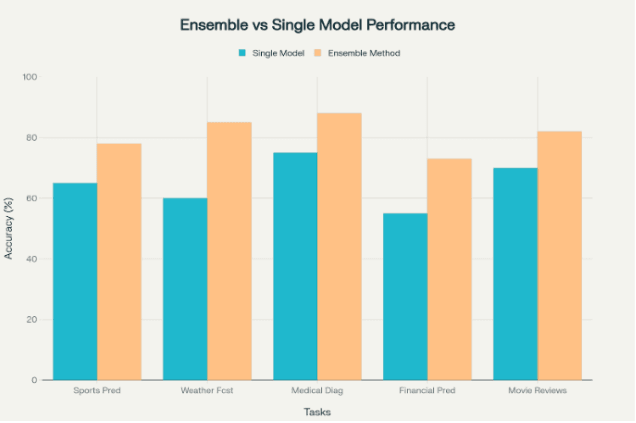
Let’s break down why ensembles work so well in each of these fields:
- Weather forecasting shows this best. Ensemble models cut precipitation forecast errors by 35–40% compared to single models. NOAA’s Global Ensemble Forecast System runs 21 forecasts to handle data uncertainties, and these ensembles predict better than single models, even at lower resolution.
- Medical diagnosis shows similar results. One study combined four models to detect a disease from patient data. The ensemble’s accuracy (AUC) rose to 0.91, meaning it was right 91% of the time. This beat any single model and led to better patient outcomes.
- Sports prediction studies back this up. Research on NBA betting found ensembles outperformed single models. Another study showed ensembles give better accuracy and more reliable risk forecasts for bettors.
Combining models systematically reduces bias and blind spots while boosting accuracy. It’s not just common sense – it’s proven math.
Why diversity matters in ensembles
Not all ensembles are equal. The key is diversity—mixing different models, algorithms, and views.
The “5 Nick Sabans” problem
Imagine College GameDay with five Nick Sabans. Same expertise, same biases, same blind spots – just louder. That’s groupthink, not an ensemble. In modeling, this happens when:
- Models use the same data and similar algorithms
- Teams share similar backgrounds and thinking
- Everyone optimizes for the same goal without variation
Research shows that when group members lack diversity, adding more doesn’t help – it can even hurt accuracy.
How to build better sports prediction ensembles
Here’s what makes a strong ensemble:
✅ Mix different algorithms: Combine statistical, machine learning, and human intuition approaches.
✅ Use diverse data: Player stats, injuries, weather, social media sentiment, betting markets, historical trends.
✅ Test and update constantly: Monitor model performance and update regularly.
Why Moddy uses ensemble modeling
At Moddy AI, diversity is in our DNA. Our creator-driven platform brings together different modeling styles, data, and expertise. Bettors build ensembles from multiple creators, blending human hunches with AI horsepower to make smarter picks. Many sports betting sites rely on one model (with a few tweaks) built by a small team. We think that’s leaving accuracy – and money – on the table.
The bottom line
The verdict’s in: teamwork beats lone-wolf expertise every time. From weather to medicine to sports betting, ensemble models consistently outperform single models by combining diverse perspectives and reducing bias. Next time you’re ready to bet, ask yourself: ❓ Am I relying on one opinion – or building a team of insights? At Moddy, we’ve built ensemble thinking into everything. Check us out and see how powerful a smarter team can be.
Further reading
- NOAA Global Ensemble Forecast System – How ensemble forecasts improve weather prediction accuracy
- ECMWF: 25 Years of Ensemble Forecasting – European Centre for Medium-Range Weather Forecasts achievements
- Ensemble Models in Medical Diagnosis – Study showing improved disease detection accuracy using ensemble methods
- Ensemble Learning in NBA Betting – Research showing how ensembles outperform single models in NBA predictions
- Advantages of Ensemble Learning in AI – Overview of ensemble benefits across AI applications
- Wisdom of Crowds: How Diversity Improves Decisions – The theory behind ensemble-like decision-making
- Rotten Tomatoes Aggregation – Example of ensemble thinking in movie reviews
- College GameDay Predictions – How ESPN uses expert ensembles in game picks