.png)



The NBA is chaos disguised as rhythm. Star players rest without warning, 20-point leads vanish in minutes, and a single hot hand can break every projection. Every bettor knows the feeling: you think you’re playing probabilities, but the sport plays you back. Static models crumble here. But to Moddy, that unpredictability isn’t a flaw — it’s training data. Moddy is an adaptive intelligencer layer for sports decision-making — learning from how the NBA behaves night after night.
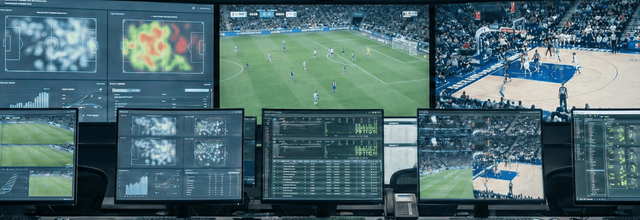
The NBA generates one of the densest data environments in professional sports — making it uniquely suited for adaptive AI systems.
The question isn’t can AI beat the NBA’s chaos — it’s how fast can it learn from it.
Nothing in this post is a guarantee or betting recommendation; it’s a look under the hood at how Moddy thinks about a very messy sport.
Why the NBA breaks traditional models
1. Small sample, huge variance Each team plays 82 games, but conditions change constantly: rest, travel, lineup shifts, officiating tendencies, and pace. A surprising number of games see massive live win-probability swings in the 4th quarter as leads evaporate and late runs flip outcomes.
Models built on season averages miss these whiplash dynamics. They assume continuity; the NBA thrives on chaos.
2. Load management kills consistency In the 1990s, many top players missed around 10 games a season on average; in the modern “load management” era, stars routinely miss 20 or more between injuries and rest. When your best player sits, your team’s identity changes overnight: pace, efficiency, and shot distribution all shift.
Most bettors treat that as noise. Moddy treats it as fresh signal. Our models continuously integrate new data as games unfold — rest patterns, lineup changes, and rotations flow directly into the system instead of being smoothed out or ignored. If the data changes, so does the model’s understanding — automatically.
3. Injuries and rotations reshape team DNA overnight A single player’s return can shift a team’s rhythm — pace, spacing, and shot quality — almost immediately. When high-usage stars come back from suspension or injury, analysis has shown noticeable changes in tempo and offensive efficiency in the following weeks as play style re-centers around them. Case in point: when Ja Morant returned to Memphis in December 2023, the team’s tempo and offensive efficiency ticked up noticeably over the following weeks as their play style rebalanced around him.
Changes like that might look subtle on paper — a few extra possessions per game — but they compound fast in model outputs. Most static models take weeks to reflect those shifts. Moddy’s data-driven framework picks up on them organically as new performance data feeds in every day.
Why the NBA Is actually perfect for AI
The same traits that break rigid models are exactly what make the NBA a perfect playground for AI.
1. High-frequency feedback loops Every NBA night produces thousands of possessions — each a mini-experiment in efficiency and probability. Where football gives you roughly 150 plays a week per team, basketball gives you tens of thousands of measurable moments across the league.
That’s fuel for learning systems. AI loves repetition — especially when each repetition comes with rich contextual data about who was on the floor, where the ball went, and how the defense reacted.
2. Granularity → adaptation Moddy’s architecture doesn’t chase one “right” model — it constantly re-weights multiple creator models based on accuracy trends. If a creator’s efficiency model starts slipping, its influence fades automatically; if another nails player-specific shooting volatility, it gains weight.
The ensemble behaves more like an ecosystem than a formula. In practice, that means Moddy is constantly running multiple ways of looking at the game in parallel and favoring the ones that are currently seeing it most clearly.
3. Data richness Unlike the NFL (low sample) or MLB (high randomness on individual events), NBA data is both dense and directional. One season gives you 1,230 regular-season games, with hundreds of potential features per team per matchup — lineup data, pace, shot profile, travel, rest, and more.
To human analysts, that’s overwhelming. To AI, it’s a playground.
How the NBA’s own AI revolution is fueling smarter modeling
The NBA isn’t just entertainment — it’s one of the most advanced data ecosystems on the planet. Every season, teams, tech partners, and analytics platforms generate millions of new data points, and that constant expansion makes the game an even better playground for Moddy’s models.
Optical tracking changed everything
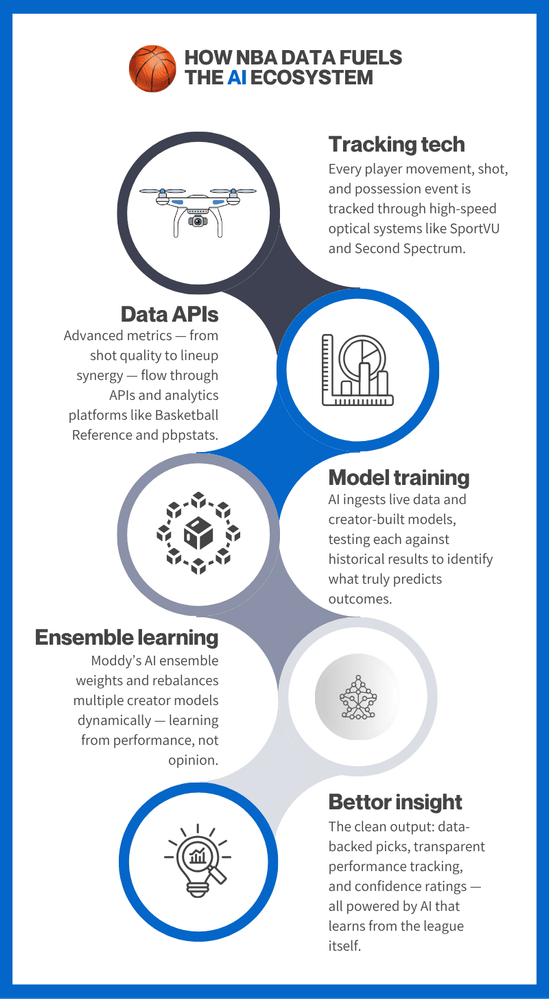
Since the league adopted optical tracking systems like Second Spectrum — a camera-based setup that tracks every player and the ball dozens of times per second — every movement, shot arc, and possession detail can be recorded in near real time.
A single game can generate millions of individual tracking data points: player speed, spacing, ball trajectory, defender proximity, and more. That’s gold for any learning system. It means Moddy’s models can incorporate richer, more granular context — translating movement and tempo into predictive signals.
AI isn’t just analyzing games — it’s redefining them
Teams now use machine learning for everything from lineup optimization to predictive fatigue management. At events like the MIT Sloan Sports Analytics Conference, researchers have showcased AI tools that estimate play success, quantify shot quality, and anticipate player workload in real time.
Moddy takes that same evolution and applies it to bettors — not coaches — modeling how human variability, pace, and rest dynamics actually impact outcomes on the betting side.
Data democratization = smarter models
Not long ago, only front offices had access to detailed shot charts, play efficiency, and possession-level data. Today, public databases and APIs make advanced metrics, tracking summaries, and play-by-play breakdowns accessible to anyone willing to dig.
That’s how Moddy builds a learning system that mirrors professional-grade analytics — without needing a locker room credential.
The same data that helps teams coach wins is now helping bettors make smarter picks. The difference is that Moddy learns from all of it — not just one team’s perspective.
The rise of AI inside the NBA has made one thing clear: the game itself is becoming self-instrumented. And that means the smartest betting models aren’t just predicting basketball — they’re learning from it in close to real time.
When chaos meets calibration: how Moddy reacts
AI doesn’t panic during cold streaks — it re-weights. The whole point of Moddy’s approach is to treat volatility as feedback, not as a reason to double down emotionally.
The hot team mirage
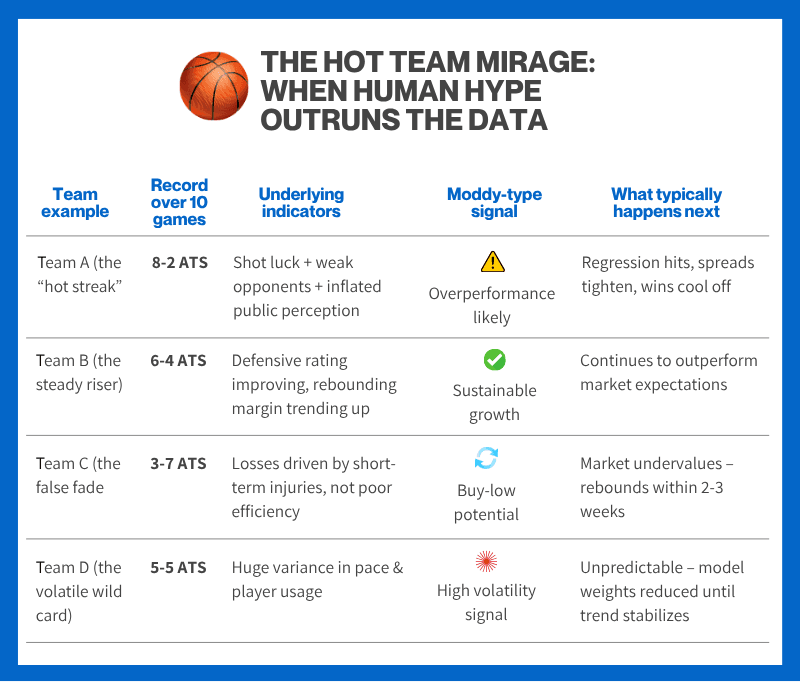
Every season, there’s a team that looks unstoppable for a few weeks — fans flood social media with “ride the streak” posts, and casual bettors follow the hype. But those runs rarely hold up when underlying indicators (shot quality, opponent strength, shooting variance) say otherwise.
A system like Moddy doesn’t “fall in love” with the record. It evaluates whether the run is driven by sustainable changes — like lineup and scheme — or by noise, and adjusts confidence accordingly.
Late scratches, early adjustments
When stars rest, sportsbooks move lines fast — but not always far enough, especially in edge-case matchups or back-to-back spots. League rules now try to limit certain kinds of star rest, but last-minute changes still happen and can reshape the game’s profile.
Moddy models those shifts with context, weighting line moves against historical volatility rather than overreacting to every piece of news. That’s how the system aims to avoid false fades in “bench” games where short-handed teams still outperform.
Volume over reaction
Over time, some model types lose precision as the season evolves — for example, approaches that overweight early-season usage or ignore emerging rotations. If nothing updates, performance quietly decays.
Moddy regularly reviews accuracy across all models and down-weights underperformers. That’s the difference between a fixed prediction engine and a learning system.
What the chaos teaches
The NBA doesn’t reward prediction; it rewards adaptation. That’s why Moddy’s philosophy is less “what’s your pick?” and more “what’s your process?”
Each season acts as a stress-test. If a model can survive NBA volatility — injuries, rest, streaks, and wild comebacks — it usually has the discipline and robustness to generalize to lower-variance sports.
The NBA isn’t an exception to modeling — it’s the proving ground for it.
Moddy’s POV
We don’t chase trends. We measure them.
Moddy isn’t here to make predictions louder — it’s here to make them smarter. The NBA is chaos, yes — but AI doesn’t need the game to slow down. It just needs the data to keep coming.
So the next time you see an underdog erase a 17-point lead or a bench squad upset a contender, remember: To the human eye, it’s chaos.
To Moddy, it’s calibration.